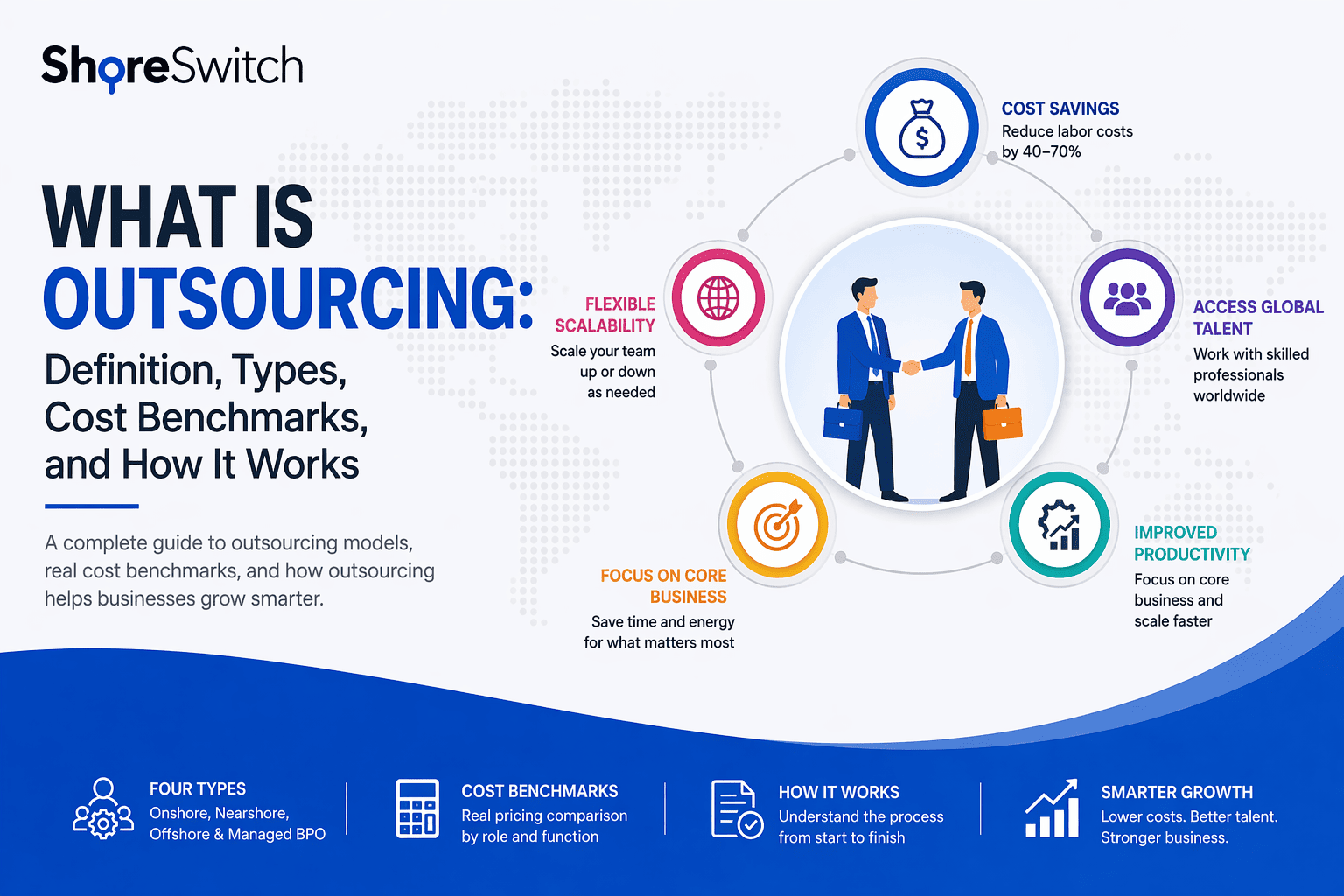

For US small and midsize businesses weighing outsourcing vs offshoring, the distinction matters more than most articles suggest. Outsourcing means hiring an external provider to handle specific business functions. Offshoring means running your own operations in a foreign country, with your staff, your processes, and your direct control. Both can reduce costs and access specialized skills, but they sit at opposite ends of the operational control spectrum. ShoreSwitch uses a managed offshore staffing model as a third option that combines the cost benefits of offshoring with the simplicity of outsourcing.
What this article covers: Outsourcing is the practice of hiring external organizations to handle business functions typically performed in-house. Offshoring involves relocating business activities to different countries where operational costs are lower. The key differences between outsourcing and offshoring center on who employs the staff and how much control you retain. Managed offshore staffing bridges these models by providing dedicated overseas team members through a specialist partner. US small businesses can use a simple decision framework to match their operational priorities to the right staffing model.
What Is Outsourcing?
Outsourcing is the practice of hiring external organizations or individuals to handle business functions that are typically performed in-house, allowing companies to focus on core activities without sacrificing overall efficiency. The service provider employs and manages the staff, while your company defines outcomes, SLAs, and KPIs without directing day-to-day work.
Outsourcing can be onshore (within the same country) or offshore (overseas). Business process outsourcing is common for functions like customer service, payroll processing, and IT support. Many companies outsource to reduce costs, access specialized expertise quickly, and convert fixed operational costs into variable costs. This model suits small and midsize businesses that need flexibility for fluctuating workloads without long-term headcount commitments.
Examples of Outsourcing in Small and Midsize Businesses
Concrete examples clarify how companies outsource to reduce labor costs and focus on core operations.
A US accounting firm might outsource after-hours customer support to a domestic call center service provider instead of hiring internal night-shift staff. The third-party company handles scheduling, training, and quality assurance. The firm pays per call handled.
A 15-person marketing agency could contract a specialist SEO firm for technical audits and content creation rather than building an in-house team. The agency reviews performance metrics and deliverables without managing the SEO team’s daily work.
A SaaS startup might outsource Level 1 IT help desk coverage to an external provider for 24/7 support, paying per ticket instead of employing a full-time team. In each case, the outsourced team uses its own tools, infrastructure, and management structure.
Key Benefits and Limitations of Outsourcing
Outsourcing offers speed and flexibility but at the cost of reduced direct control over business processes. Understanding these trade-offs helps you decide whether this model fits your operational priorities.
Benefits:
- Rapid onboarding without recruitment or training overhead
- Access to specialized skills and specialized talent without full-time hires
- Predictable pricing that helps reduce operational costs
- Scalability allows companies to rapidly increase or decrease work volume without hiring or firing staff
- Outsourcing allows internal teams to concentrate on core competencies, providing a competitive edge
Limitations:
- Businesses that outsource relinquish day-to-day oversight to their vendors and contractors, which may have their own quality assurance processes and standards, leading to potential inconsistencies in service quality
- Outsourcing can lead to a loss of control due to limited visibility into how tasks are performed and managed
- High reliance on a third-party vendor introduces dependency risks related to their stability and security protocols
- Outsourcing relationships are exposed to geopolitical risks involving political instability or regulatory changes in a foreign country
- Outsourcing can lead to misalignment and data security risks if vendor selection is not handled carefully, as companies may have less visibility into the operations of third-party providers
Outsourcing works best for clearly defined, repeatable, specific business processes where outcomes can be specified in a contract. Companies outsource when they want to focus on core operations and are comfortable treating certain business functions as a managed black box.
What Is Offshoring?
Offshoring involves relocating business activities or processes to different countries where operational costs are lower, allowing companies to reduce costs while maintaining control over these operations. Unlike outsourcing, you retain direct management over the offshore team as part of your company.
Offshoring may involve opening a subsidiary, captive center, or long-term presence in another country, such as the Philippines. The offshore workers are treated as employees, using your tools, following your processes, and reporting into your management structure. Offshoring is, by definition, international, unlike outsourcing, which can be either domestic or international.
Companies choose offshoring when they want significant cost savings and are willing to invest in infrastructure, compliance, and direct management of overseas operations. This model is common in software development, back-office processing, and customer support in offshore locations with a skilled workforce.
Examples of Offshoring in Real Businesses
These examples illustrate offshoring where the company owns the overseas operation and treats staff as employees.
A US ecommerce brand might establish a 50-person customer service and order-processing team in Cebu, Philippines, with its own office, local HR, and managers directly reporting to US leadership. This approach enables e-commerce offshore support staff to operate as a true extension of the domestic teams.
A mid-market technology company could open a software development center in Ho Chi Minh City to access skilled professionals at lower labor costs. The team follows the company’s agile methodology and uses internal tools.
A financial services firm might set up a back-office data processing unit in Manila, employing analysts who follow the firm’s internal policies and proprietary software. In each case, the offshore team uses the company’s tools and workflows. Management responsibility remains with the company rather than a third-party provider.
Advantages and Disadvantages of Offshoring
Offshoring is a long-term business strategy that can unlock significant cost savings but requires higher operational complexity.
Advantages:
- Offshoring allows companies to directly manage their overseas teams, implement their own processes, and enforce their own quality control standards, often resulting in more consistent quality
- Reduced labor costs and operational costs over time through lower costs in foreign markets
- Time zone differences can be for 24/7 productivity
- Full control over training, company culture, and customer experience
- Ability to scale operations with dedicated teams aligned to your global expansion goals
Disadvantages:
- Offshoring can face challenges related to local laws, tax regulations, and labor standards in offshoring locations, making compliance management essential for businesses
- Requires investment in offices, infrastructure, and human resources management
- Cultural and communication gaps can present risks in offshoring, requiring intentional strategies to bridge differing approaches to decision-making and work styles across regions
- Effective management in offshoring requires a strong understanding of cultural differences and communication styles to ensure smooth operations across borders
- Companies that choose offshoring must invest in compliance management to navigate local laws and regulations, which is a critical responsibility for management teams
Offshoring is best suited for companies seeking substantial, ongoing cost reductions and the ability to build dedicated teams that can scale operations over the long term. It requires relocating operations with a multi-year commitment, not just a quick fix for seasonal overflow.
Outsourcing vs Offshoring: Key Differences
The main distinction between outsourcing and offshoring lies in where and how work is carried out; outsourcing delegates tasks to external vendors, while offshoring retains company control over operations conducted abroad. These two models are often confused, but they differ fundamentally in who employs the staff, where work takes place, and how much operational control you retain.
Both outsourcing and offshoring can deliver cost savings, cost efficiency, and access to global markets. But they sit at different points on the spectrum of business process control. US small businesses can also combine both outsourcing and offshoring in hybrid models, depending on the business functions involved.
Cost Structure and Scalability
Both outsourcing and offshoring are used to reduce costs and enable scaling operations, but their cost structures differ over time.
Outsourcing can reduce labor costs by allowing companies to pay only for the services they need, which helps shift from fixed to variable costs, providing immediate benefits related to cost management and flexibility. Outsourcing allows for rapid scaling by relying on external providers to handle fluctuations in demand, whereas offshoring requires investing in infrastructure and talent management, which can be a long-term commitment.
Offshoring typically requires substantial upfront investments in infrastructure and personnel, but over time, it can lead to significant cost reductions through lower labor costs and reduced overhead. Companies looking for cost reduction over multiple years often find that offshoring delivers stronger ROI once the initial setup is complete.
Operational Control and Quality Management
Operational control over business processes is the main difference between outsourcing and offshoring for most founders weighing these options.
In outsourcing, the vendor owns the hiring process, training, scheduling, and quality assurance. You manage by contracts, SLAs, and regular check-ins rather than directly managing each team member. Quality control in offshoring can be enhanced through direct management of offshore teams, which allows for better alignment with company culture and operational standards, leading to higher quality outcomes.
Offshoring necessitates direct control over operations, meaning that management must oversee not only the workforce but also the processes and infrastructure involved. Greater control comes with greater responsibility: you design performance monitoring, communication routines, and escalation paths yourself.
Businesses handling sensitive data or brand-critical customer interactions may favor models with more direct control, especially when maintaining quality and customer experience is central to their business strategy.
Infrastructure, Technology, and Compliance
Who owns the infrastructure and technology stack is another core difference that drives both risks and costs between outsourcing and offshoring.
In outsourcing, the service provider supplies offices, hardware, software licenses, and security protocols. Your company mainly defines requirements and audits compliance where needed. The external provider handles the operational burden.
In offshoring, your company invests in or specifies the office environment, hardware, software, and time-tracking tools. You must ensure compliance with both US and host-country foreign regulations. This includes managing employment contracts, benefits, data protection requirements, and tax obligations in the foreign jurisdiction.
For smaller companies, this compliance burden can be a barrier to pure offshoring. This is why intermediary models like managed offshore staffing have emerged to handle these responsibilities.
Time Zones, Culture, and Communication
Geography affects collaboration in both outsourcing and offshoring, especially when remote teams operate across multiple time zones.
Offshore locations such as the Philippines often work night shifts to match US hours. This requires thoughtful scheduling, handover routines, and communication tools to avoid misunderstandings. Operational friction may arise from communication breakdowns due to language barriers and cultural differences.
Outsourcing vendors may offer blended overseas teams in different regions to cover 24/7 global operations, while offshoring requires you to design schedules and staffing models yourself. Cultural differences, holidays, and work norms can affect both models and must be addressed through training, clear expectations, and regular check-ins.
Small businesses should consider whether they want to own these cross-cultural management tasks or rely on an experienced partner to handle communication challenges.

Where Managed Offshore Staffing Fits Between Outsourcing and Offshoring
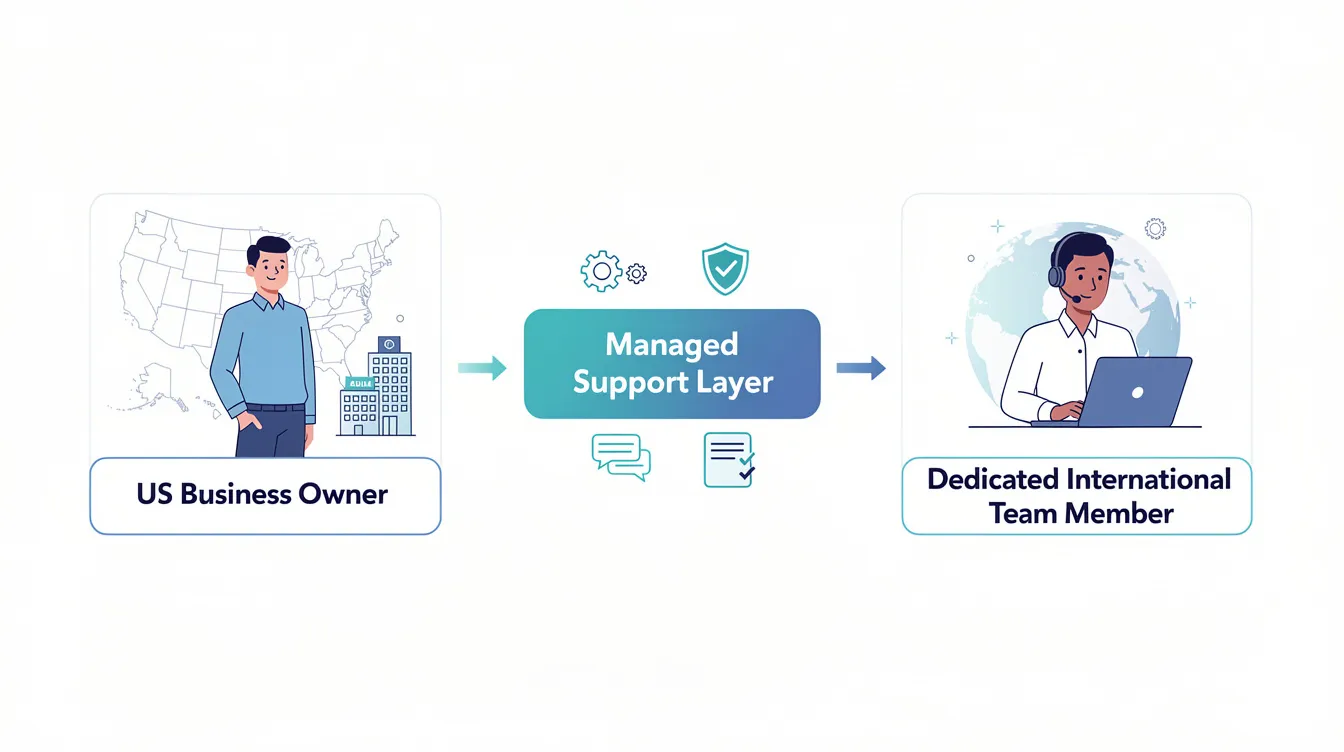
Managed offshore staffing is a hybrid model: you get dedicated offshore staff in a foreign country (similar to offshoring) while a specialist partner handles recruitment, infrastructure, compliance, and day-to-day support (similar to outsourcing). This structure delivers the long-term strategic benefits of offshoring without requiring you to build your own entity abroad.
ShoreSwitch operates in this managed offshore staffing category, connecting US small businesses with full-time team members in the Philippines. Under this model, staff work only for your company, integrated into your workflows and internal resources. You avoid the burden of setting up your own offshore operations or learning foreign labor laws from scratch.
Managed offshore staffing sits between outsourcing and DIY offshoring on the operational control spectrum. You get more control than outsourcing, less overhead than maintaining control through a fully owned subsidiary. This is particularly relevant for offshore staffing solutions for small businesses where founders want to reduce costs and maintain consistent quality without becoming HR and compliance experts for other countries.
How the Managed Offshore Staffing Model Works in Practice
The process begins with a consultation where your business clarifies the role of a virtual assistant, bookkeeper, graphic designer, sales representative, or team leader along with your desired schedule, tools, and business activities.
The managed staffing partner runs recruitment in the Philippines, screens candidates from the skilled workforce, checks experience, and presents a shortlist tailored to your business functions and industry. Companies looking for offshore bookkeeping and accounting support can specify accounting software proficiency and industry experience.
Once hired, the offshore team member works exclusively for you, follows your processes, and joins your communication channels. The partner handles payroll, compliance documentation, local benefits, and time-tracking setup. Ongoing support includes dual check-ins with both you and the staff member, assistance with performance improvements, and troubleshooting of any operational or cultural issues.
Why US Small Businesses Choose Managed Offshore Staffing
This model directly addresses common small-business pain points: limited budget for domestic hires, lack of internal resources for HR administration, and fear of losing control when they outsource to a third-party provider.
Managed offshore staffing offers cost savings similar to offshoring by hiring in lower-cost markets like the Philippines, without requiring you to form a local entity or navigate every regulation. Access to specialized expertise enables companies to obtain niche skills that are too expensive to hire in-house.
Unlike outsourcing, this model gives you a dedicated offshore team member who works only on your tasks and becomes part of your culture and core business. This approach works well for ongoing roles that support core operations, customer support, administrative assistants, offshore digital marketing specialists, and design work.
Outsourcing vs Offshoring vs Nearshoring vs Managed Offshore Staffing
Beyond outsourcing and offshoring, nearshoring and managed offshore staffing broaden the range of options for delegating work globally. Nearshoring means relocating operations to a nearby country, for example, US companies working with providers in Mexico or Canada to balance cost reduction with fewer time zone differences.
All four models aim to reduce costs, access specialized skills, and support scaling operations. They differ mainly in:
- Location: Domestic, nearby country, or distant foreign country
- Who employs staff: Third party company, your subsidiary, or managed partner
- Cost profile: Variable fees, high upfront capex, or moderate partner fees
- Operational control: Low (outsourcing), high (offshoring), medium-high (managed offshore)
Best Use Cases for Each Model
Choosing the right model depends on the nature of the work, duration, and strategic importance to your business operations.
- Outsourcing fits short-term projects, seasonal spikes, or non core functions like one-off marketing campaigns or temporary customer support overflow
- Offshoring works when you need long-term, high-volume work under your full control, such as building an internal software development or back-office center to expand operations
- Nearshoring suits teams requiring frequent real-time collaboration with fewer time zone differences
- Managed offshore staffing is ideal for midsize businesses hiring their first or second overseas team member for ongoing roles where they want cost efficiency plus dedicated support
Decision Framework: Which Model Fits Your Business?
Start from your goals: cost reduction, access to specialized skills, speed, and desired level of operational control. Walk through key questions about your business activities and streamlining operations needs.
Key questions to ask:
- Is this a project-based need or an ongoing role?
- Do you need the worker embedded in your daily standups?
- How sensitive is the data they will handle?
- How important is direct control over training and performance?
- Do you have the bandwidth to manage foreign compliance?
If the work is short-term or experimental, outsourcing is usually safer. If the work is core and long-term, offshoring or managed offshore staffing may be better. Small businesses with limited HR capacity but a need for ongoing help should consider managed offshore staffing.
Visual Comparison: Three Delegation Models
A visual can help founders quickly compare outsourcing, offshoring, and managed offshore staffing across the key differences that affect daily business strategy.
The comparison graphic (outsourcing-offshoring-comparison.jpg) shows three columns for each model with rows covering Control, Cost Structure, Staff Ownership, and Best For scenarios. This structured comparison helps match your operational priorities to the right approach without wading through pages of text.
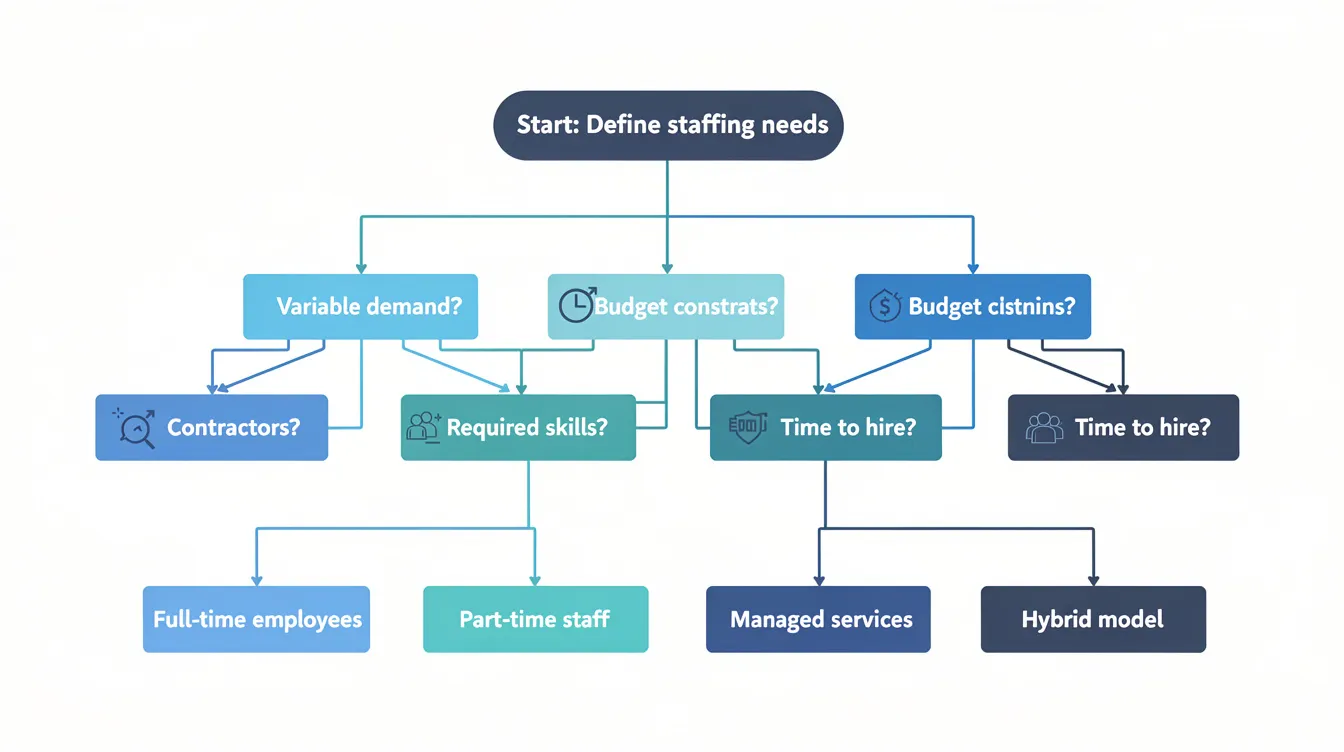
Step-by-Step Questions for SMB Owners
Use this sequence to narrow your options:
- Is the role ongoing or project-based? Project-based with low integration needs → outsourcing. Ongoing → continue.
- Do you need the worker in daily standups? No → outsourcing may work. Yes → continue.
- How sensitive is the data? High sensitivity → models with direct control (offshoring or managed offshore).
- Do you have HR bandwidth for international compliance? Yes → consider DIY offshoring. No → managed offshore staffing.
- What’s your budget horizon? Immediate flexibility → outsourcing. Multi-year cost reduction → offshoring or managed offshore.
The decision-tree image (smb-offshore-staffing-decision.jpg) represents this branching logic visually, leading from initial questions to recommended models based on your answers.
FAQs: Outsourcing vs Offshoring for Small Businesses
Is offshoring cheaper than outsourcing over time? Offshoring typically delivers greater cost savings over multiple years because you avoid vendor markups. However, outsourcing often costs less upfront.
Is offshoring better than outsourcing for quality control? Offshoring generally offers better quality control because you directly manage the team, set standards, and enforce processes. Outsourcing relies on vendor quality assurance, which can vary. Maintaining quality becomes easier when you have direct oversight.
Is outsourcing a type of offshoring? No. Outsourcing can happen domestically within the same country or internationally. Offshoring specifically means relocating work to a foreign country. Offshore outsourcing involves hiring a third-party provider located overseas.
How do I start with managed offshore staffing? Start with one role that supports your core operations a virtual assistant, bookkeeper, or administrative support. Managed offshore staffing lets you pilot the model at lower risk before committing to a broader global workforce. This is often the easiest on-ramp for businesses new to global economy talent sourcing.
Conclusion: Choosing the Right Model for Sustainable Growth
Outsourcing and offshoring are distinct tools for cost savings and global expansion. Managed offshore staffing provides a third path that balances control and simplicity, making it accessible for US small businesses without enterprise-level resources.
The right choice depends on your business strategy, the nature of the work, your need for maintaining control, and your bandwidth to manage international teams. Production costs, project work, and internal teams’ capacity all factor into the decision.
If you are considering which roles in your company could be handled by a dedicated offshore team member supported by a trusted partner, start small. Pilot one managed an offshore role as a bookkeeper, virtual assistant, or customer support specialist. That first step often answers more questions than months of research.