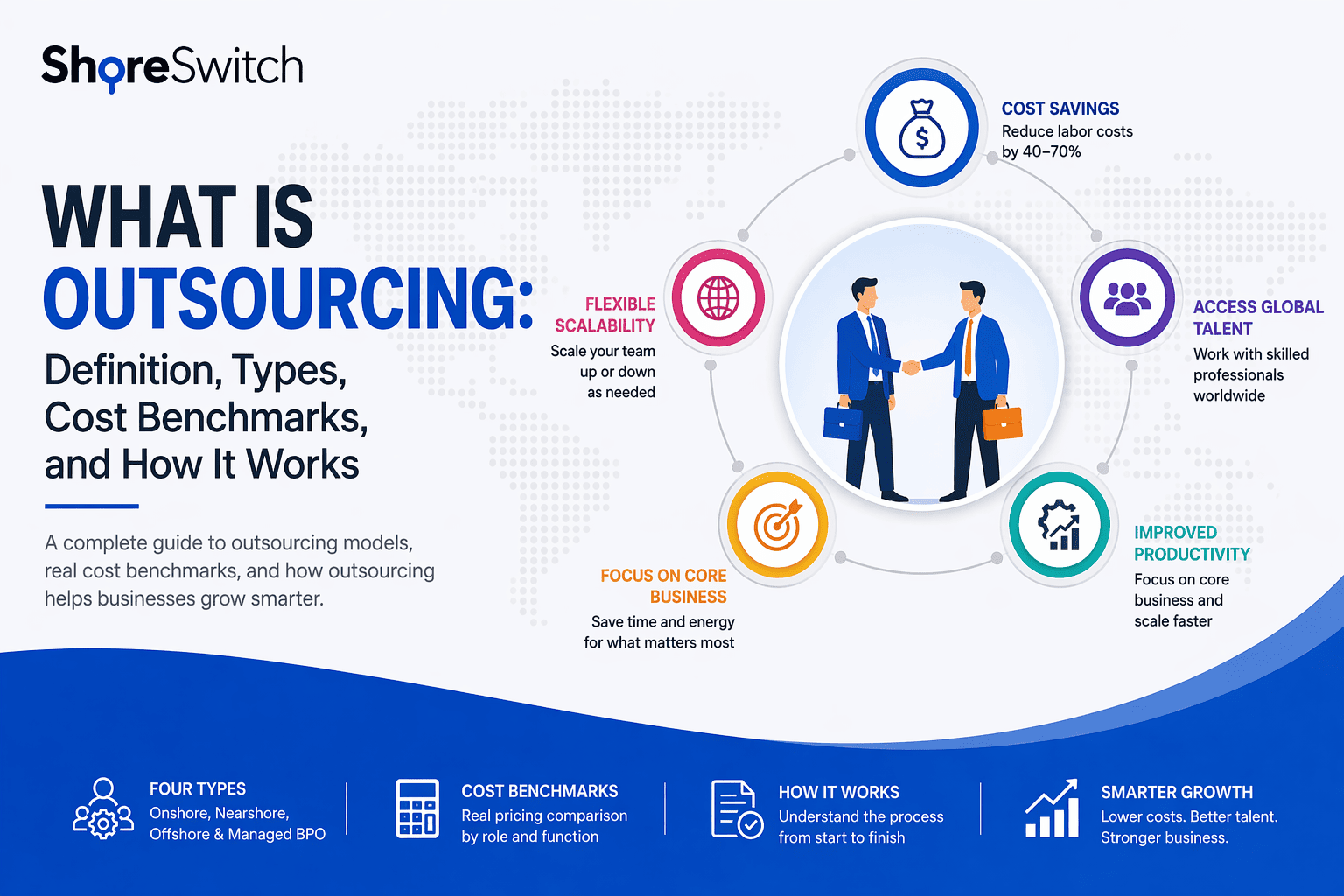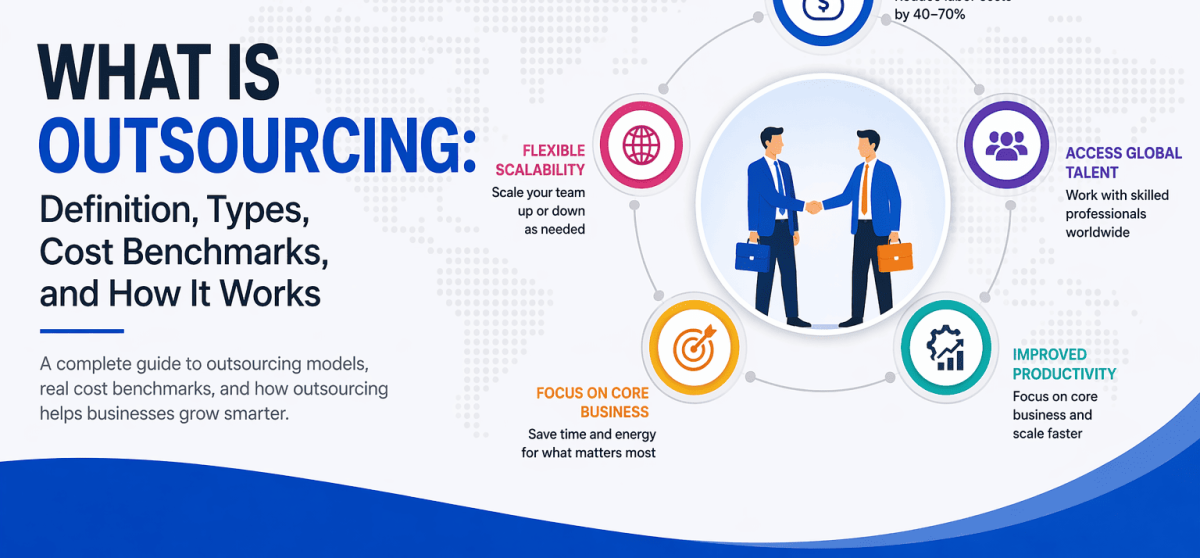
Outsourcing is the business practice of contracting an external third-party provider to perform tasks, manage operations, or deliver services a company’s internal team would otherwise execute. For small businesses, outsourcing means hiring external, third-party specialists to perform non-core tasks, such as accounting, IT support, or marketing. Commonly outsourced services include accounting, marketing, customer support, human resources, shipping, web design, and payroll. Small businesses use outsourcing to reduce total labor costs by 40–70%, access specialist skills without full-time recruitment, and redirect owner time toward revenue-generating work.
Four distinct models exist: onshore, nearshore, offshore, and managed BPO, each differing by geography, cost structure, and how much operational management the business retains. A fully managed BPO provider absorbs recruitment, payroll, HR compliance, and performance monitoring, removing both the work and the overhead of managing it.
Businesses ready to outsource show three consistent signals: a skill gap the internal team cannot fill, a task that drains time without generating revenue, and a scoped project that does not justify a permanent hire.
Data shows that 83% of small businesses will continue or increase their spending on outsourcing services in 2023, highlighting the growing trend.
Outsourcing Means Contracting an External Party to Perform Work Your Business Would Otherwise Handle In-House
Outsourcing is the business practice of contracting an external party to perform certain tasks, handle operations, or deliver services that your business would otherwise manage in-house.
When outsourcing, it is crucial to set clear expectations by defining the project scope, deliverables, and deadlines upfront to ensure effective communication and project success.
How the Third-Party Delivery Model Works
The external provider, often referred to as an external vendor or service provider, can be an individual contractor, a staffing agency, or a BPO firm. These service providers receive defined work, execute it using their own staff or systems, and deliver outputs to the hiring company.
Outsourcing converts internal fixed employment costs into variable external expenses. The business pays for output, not for headcount, office space, equipment, or benefits.
Outsourcing services can improve efficiency by leveraging the expertise and advanced tools of external vendors. Third-party providers often have better tools and processes, allowing tasks to be completed faster and more accurately.
This model first appeared as a formal business strategy in 1989. It has since expanded from manufacturing to encompass every service-based business function.
What Separates Outsourcing from Insourcing and Freelancing
Outsourcing is a structured business decision with a defined scope, a provider agreement, and ongoing accountability for outcomes. Establishing clear communication channels and setting expectations upfront is essential to ensure successful outsourcing relationships and avoid miscommunications or missed deadlines.
Insourcing is the opposite, bringing previously external functions back inside the business under direct employment.
Freelancing is transactional. One task, one payment, no ongoing management structure. Outsourcing through a structured provider establishes recurring delivery, SLA terms, and performance monitoring. When choosing an outsourcing partner, businesses should look for providers with a proven track record, relevant expertise, positive reviews, and a strong communication strategy.
Small Businesses Outsource to Reduce Labor Costs by 40–70%, Access Specialist Skills, and Reclaim Time for Core Operations
Small businesses outsource primarily to achieve cost savings, save money, and reduce costs by delegating non-core tasks. This approach can reduce total employment costs by 40–70% compared to equivalent in-house hires, while also providing access to specialist skills that full-time recruitment cannot justify at the required weekly hours.
Outsourcing improves overall efficiency and operational efficiency by freeing up valuable resources and allowing businesses to focus on their core competencies. By leveraging external resources, small businesses can increase efficiency and allocate resources to growth activities. As small businesses grow, outsourcing supports their ability to thrive by providing access to expertise and scalability.
By delegating time-consuming routine tasks, owners can spend more time on revenue-generating activities like product development and sales.
Real Cost Comparison: In-House Hire vs Outsourced Role by Function
| Role | In-House Annual Cost (US) | Outsourced Monthly Cost | Annual Outsourced Equivalent |
|---|---|---|---|
| Bookkeeper | $70,000–80,000 | $200–500 | $2,400–6,000 |
| Senior Business Analyst | $150,000 (with benefits) | ~$4,200 | $50,000 |
| VA, generalist | $50,000–60,000 | From $600 | $7,200+ |
| Social media manager | $55,000–65,000 | $500 (offshore) | $6,000 |
Outsourcing is especially beneficial for small businesses operating on a tight budget, as it helps cut costs and reduce overhead costs by minimizing expenses related to office space, staff, and operational needs.
Offshore staffing eliminates recruitment fees, employer payroll tax, annual leave liability, office overhead, and equipment costs. Those eliminated costs represent 30–40% above base salary for most US small business hires.
Additionally, companies that outsource their work are not required to fulfill the same legal obligations as companies that hire employees, which can lead to significant cost savings.
Why Mental Load Reduction Matters as Much as Cost Reduction
Most small business owners do not just carry too much work. They carry too many decisions.
When a business owner becomes the default bookkeeper, IT person, and HR manager, they stop making strategic decisions. They manage operational chaos instead.
Making informed decisions about what to outsource enables business owners to focus on their most important activities, ensuring that their time and energy are directed toward core business priorities.
Outsourcing transfers decision ownership for non-core functions to a provider with defined accountability. The mental load reduction, not just the cost saving, is what drives the highest satisfaction outcomes among businesses that outsource successfully.
The Four Types of Outsourcing Differ by Geography, Management Structure, and Cost Level
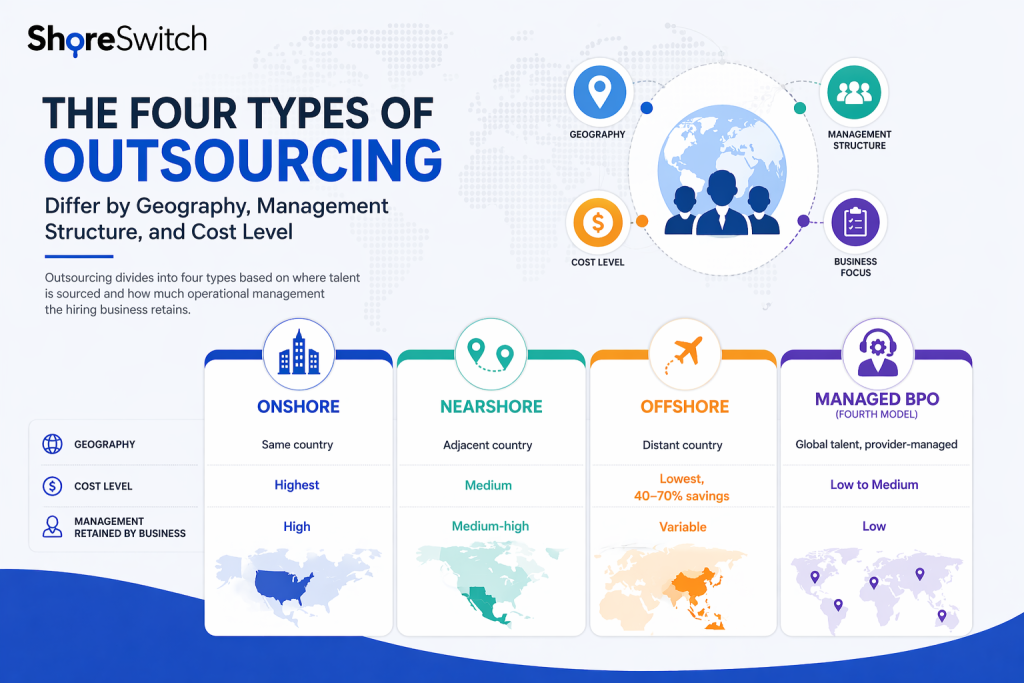
Outsourcing divides into four types based on where talent is sourced and how much operational management the hiring business retains. Selecting the right outsourcing company is crucial for successful outcomes, as it ensures your business’s specific requirements are met and quality work is delivered.
Choosing the right outsourcing partner—one who aligns with your business needs, communicates effectively, and has relevant expertise—is essential for a successful outsourcing relationship.
Onshore, Nearshore, and Offshore Outsourcing Compared
| Type | Geography | Cost Level | Management Retained by Business |
|---|---|---|---|
| Onshore | Same country | Highest | High |
| Nearshore | Adjacent country | Medium | Medium-high |
| Offshore | Distant country | Lowest, 40–70% savings | Variable |
Offshore outsourcing produces the largest cost differential. A Philippines-based specialist costs 40–70% less than an equivalent US-based hire across administrative, marketing, and IT functions. For many small businesses, establishing a dedicated manufacturing facility is cost-prohibitive, so outsourcing to offshore or domestic partners offers a more flexible and affordable solution.
Managed BPO, The Fourth Model Where the Provider Owns Outcomes, Not Just Tasks
A managed BPO (Business Process Outsourcing) provider handles recruitment, candidate screening, onboarding, payroll, HR compliance, and performance monitoring as a single integrated service. Managed BPO can also be structured as shared services, where multiple business functions are managed collaboratively across organizations.
The business owner defines the role requirements and KPIs. The provider delivers staffed, managed, compliant output. No direct management of offshore employees is required.
What a Managed BPO Provider Handles That the Other Three Models Do Not
- Offshore payroll processing and international transfer management
- Local taxation compliance in the talent’s country of residence
- Time, attendance, and leave management
- Employee benefits, health cover, and statutory entitlements
- Weekly performance reporting against defined KPIs
- Mediation and dispute resolution between the client and offshore staff
ShoreSwitch operates as a fully managed BPO provider. Businesses access Philippines-based talent across 7 verticals: administrative, real estate, e-commerce, digital marketing, IT, finance, and promotional products, with no lock-in contracts.
9 Business Functions Small Businesses Outsource Most, With Real Cost Benchmarks
Small businesses most commonly outsource services such as accounting, marketing, customer support, human resources, shipping, web design, and payroll. Marketing is frequently outsourced by small businesses to leverage external expertise in ad design, content creation, and social media management, allowing internal teams to focus on core operations. Commonly outsourced tasks also include customer service, IT management, and administrative tasks, which help small businesses improve efficiency and focus on growth.
Administrative and Back-Office Functions
Bookkeeping and Payroll, $200–500/Month vs $70,000–80,000/Year In-House
A Philippines-based bookkeeper certified in XERO, QuickBooks, or MYOB costs $200–500/month. The same role locally costs $70,000–80,000/year, including benefits.
Outsourced bookkeepers reconcile accounts, process invoices, manage accounts payable and receivable, and prepare tax-ready financial reports on a monthly cadence.
Virtual Assistance and Scheduling, From $600/Month for a Full-Time Offshore VA
A full-time offshore VA handles inbox management, calendar coordination, data entry, appointment setting, and CRM updates for $600–900/month. The equivalent local hire costs $4,000–5,000/month.
HR Administration, Payroll Processing, Leave Management, and Benefits Handling
Outsourcing human resources (HR) administration, including HR tasks like payroll processing, onboarding, and compliance, can be highly effective for small businesses. Benefits administration is a key component of HR outsourcing, covering health insurance, retirement plans, and leave management. Delegating non-core tasks such as HR administration to external providers allows business owners to focus on core activities, increase efficiency, and reduce costs.
Many small businesses find that once they have between 10 and 15 employees, HR demands become too complex to manage without specialized knowledge, making outsourcing a viable option. HR outsourcing can be especially effective for small businesses that are growing quickly or struggling with compliance.
Outsourcing HR tasks such as payroll processing, employee benefits administration, and compliance can save small businesses time and money while allowing them to focus on core business activities. A managed BPO provider handles this within the service package; no separate HR vendor required.
Customer-Facing and Marketing Functions
Customer Service, Full-Time Outsourced Agent From $250/Month
Offshore customer service agents handle inbound inquiries, complaint resolution, live chat, and email support for $250–500/month. Locally, equivalent full-time customer service coverage costs $3,500–5,000/month.
Digital Marketing and SEO, $500–1,500/Month Offshore vs $5,000–8,000/Month Locally
Offshore digital marketing specialists manage SEO audits, PPC campaign monitoring, blog production, and email marketing workflows. The cost differential against US-based equivalents ranges from 60–75%.
Social Media Management, $500/Month Offshore vs $4,000+/Month Locally
A full-time offshore social media manager produces, schedules, and monitors content performance across platforms for $500/month. That same role in the US costs $4,000–5,500/month.
Technical Functions
IT Support, Most Effective for Businesses Under 10 Staff
Outsourced IT support covers help desk, Office 365 administration, system monitoring, security patching, and backup management.
The primary value for small teams is not cost reduction alone. It is removing the business owner from the role of default IT person, a role that absorbs hours of decision-making time weekly without generating revenue.
Outsourcing Through a Managed BPO Provider Removes Both the Work and the Management Overhead
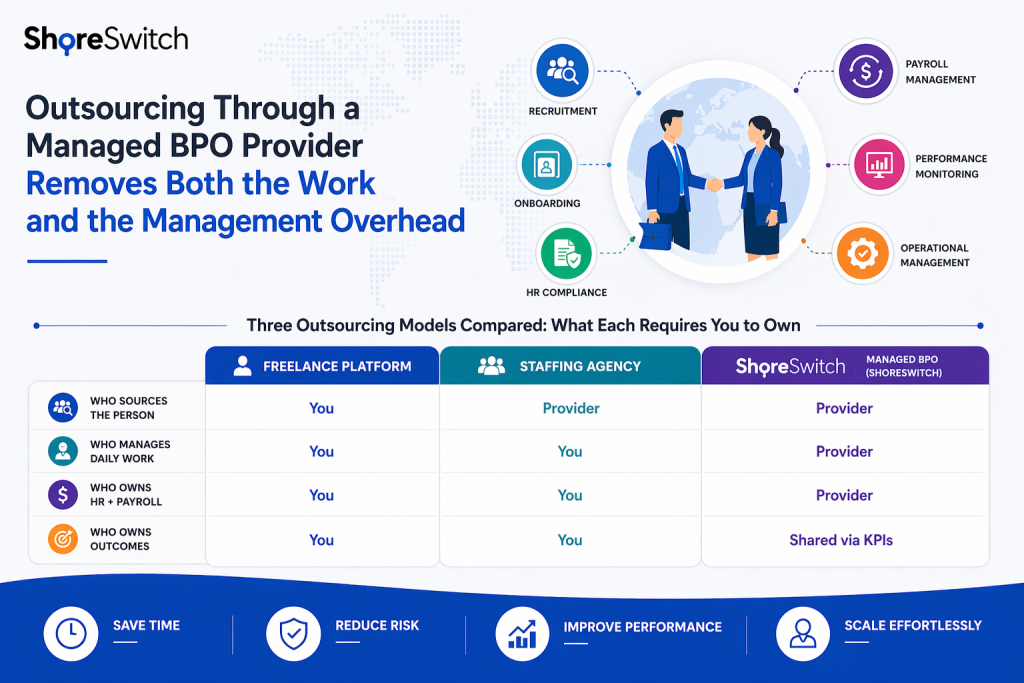
A managed BPO provider absorbs recruitment, onboarding, payroll, HR compliance, and performance monitoring. The business owner defines the role and receives the outputs without managing the operation directly. Working with an outsourced team requires effective management and coordination to ensure tasks are completed efficiently. Selecting the right outsourcing partner is essential for building a successful outsourcing relationship.
Three Outsourcing Models Compared: What Each Requires You to Own
| Model | Who Sources the Person | Who Manages Daily Work | Who Owns HR + Payroll | Who Owns Outcomes |
| Freelance platform | You | You | You | You |
| Staffing agency | Provider | You | You | You |
| Managed BPO (ShoreSwitch) | Provider | Provider | Provider | Shared via KPIs |
What You Still Own When Outsourcing Through a Freelance Platform
Freelance platforms transfer access to talent. They do not transfer management overhead.
The business still owns sourcing, vetting, briefing, revision management, payment processing, and performance accountability. If the freelancer underdelivers, the business absorbs the consequence.
What a Managed BPO Provider Absorbs from Your Operations
- End-to-end candidate sourcing and shortlisting
- Offshore payroll and international compliance
- KPI implementation and monthly performance reporting
- Leave, attendance, and workforce management
- Continuity planning if a team member exits
Why Outsourcing Tasks Instead of Outcomes Produces the Same Chaos in a New Location
The most common outsourcing failure: businesses delegate a list of tasks without defining who owns the result. Outsourcing non-core tasks allows businesses to focus on their core competencies, ensuring that their main strengths and differentiators receive the most attention. By delegating non-core tasks to external providers, small businesses can streamline operations and improve efficiency.
The business owner becomes an accidental project manager for an offshore vendor. The workload shifts location but does not reduce.
Managed outsourcing transfers outcome ownership to a structured provider with contractual accountability. The KPIs define success. The provider delivers or reports against them.
3 Signals Tell You a Specific Task Is Ready to Outsource
A task is ready to outsource when it requires a specialist skill the business does not hold, consumes time that does not generate revenue, or represents a scoped project that does not justify a permanent hire. Outsourcing provides knowledge small businesses may lack in-house, such as expertise in finance, marketing, or IT. Accessing external expertise and specialized knowledge is a key benefit of outsourcing, helping small businesses improve compliance, efficiency, and growth.
Signal 1: The Task Requires a Specialist Skill Your Team Does Not Currently Hold
Examples: XERO-certified bookkeeper, Shopify product manager, Google Ads specialist, technical SEO auditor.
Hiring full-time cannot be justified when the role requires 15–20 hours per week. Outsourcing fills that gap without the employment overhead.
Signal 2: The Task Is Necessary But Does Not Directly Generate Revenue
Examples: inbox management, invoice chasing, appointment scheduling, data entry, and social media posting.
Non-revenue tasks consume owner time without compounding returns. Many of these are time-consuming, and outsourcing them allows business owners to focus on higher-value activities. Every hour spent on these tasks is an hour not spent on sales, product, or client delivery.
Signal 3: The Task Is a One-Time Project With a Defined End Date
Examples: website build, CRM migration, accounting system setup, and content audit.
A permanent hire for a defined-end project creates post-project headcount overhead. Outsourcing delivers the outcome and ends cleanly when the project closes.
The Risks of Outsourcing Follow Predictable Patterns; Each Has a Structural Fix
The three most common outsourcing risk, quality inconsistency, communication breakdown, and data security exposure—share the same root cause: unclear ownership of outcomes. Outsourcing can also support business continuity by helping small businesses maintain operations during disruptions or unforeseen events.
However, working with external teams can lead to communication issues, such as delays or misunderstandings, especially when teams are in different time zones. It is crucial to protect intellectual property when outsourcing by using non-disclosure agreements and secure communication channels to safeguard sensitive business information.
| Risk | Root Cause | Structural Fix |
|---|---|---|
| Quality inconsistency | No measurable KPIs defined upfront | Set deliverable benchmarks before engagement starts |
| Communication breakdown | No defined check-in cadence or response SLA | Weekly reporting + defined response time windows |
| Data security exposure | Unvetted provider, no data handling protocol | Providers with documented encryption and privacy protocols |
| Dependency risk | Single provider for critical functions | Managed BPO with built-in continuity and handover structure |
A managed BPO provider owns these risk mitigation structures as part of the service. The business owner does not carry risk management as an additional overhead.
Frequently Asked Questions
What is the difference between outsourcing and offshoring?
Outsourcing means contracting any external party to perform a business function; the provider can be domestic or international. Offshoring specifically relocates that work to a provider in another country to reduce labor costs. All offshoring is outsourcing. Not all outsourcing is offshoring. [Read: Outsourcing vs Offshoring]
What tasks should a small business outsource first?
The highest-ROI starting points are bookkeeping ($200–500/month), virtual assistance (from $600/month), and customer service ($250–500/month). These three consume the most owner time without directly generating revenue.
How much does outsourcing cost for a small business?
A general VA costs from $600/month through a managed BPO provider. Bookkeeping runs $200–500/month. Digital marketing specialists cost $500–1,500/month offshore versus $5,000–8,000/month locally. Managed BPO pricing includes payroll, HR, and performance monitoring within that cost.
Is outsourcing good or bad for small businesses?
Outsourcing produces positive outcomes when the provider owns a defined outcome with measurable KPIs. The most common failure is outsourcing tasks without defining who owns the result. When structured through a managed BPO model, outsourcing reduces costs by 40–70% and removes significant operational burden.
How do I start outsourcing my business tasks?
List the five tasks consuming the most time without generating revenue. Apply the three-signal test: skill gap, time drain, or one-time project. Then choose between a freelance platform, a staffing agency, or a managed BPO provider. [Read: How to Outsource Work]
ShoreSwitch connects US small businesses with fully managed Philippines-based talent across 7 industry verticals. Recruitment, payroll, HR, and performance monitoring are handled end-to-end. No lock-in contracts.